Market Square or Community Hall: Two Kinds of Meeting Place
Market square or community hall: see how weather, access and layout shape gatherings, so you can choose a setting that suits the people and purpose.
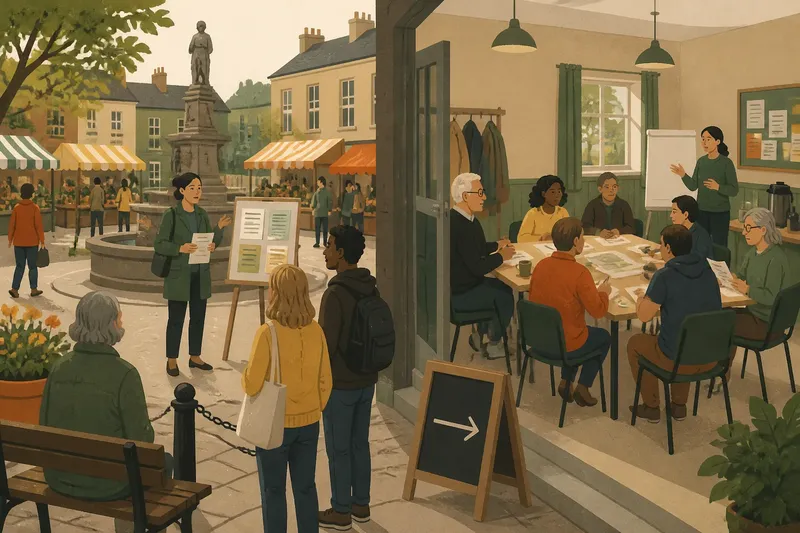
Should you meet in a market square or a community hall? The choice changes what people can hear, how easily they arrive, and what happens when the weather turns. A square makes a gathering part of the street; a hall gives it a door, a roof and a more controlled room.
These are not rival versions of the same venue. Each has a different relationship with passing life, shelter and movement. The useful question is what the gathering needs people to do together.
A square keeps the street in the gathering
Market squares suit events that can tolerate interruptions: a seasonal stall day, an informal performance, a public notice table or a meeting where people may stop briefly rather than stay throughout. The open edge lets passers-by join without first deciding to enter a building. That can make the event feel available, though it also means attention comes and goes.
Layout matters. A fountain, statue, planted bed or line of market stalls can divide a square into smaller pockets. Those features may give people a natural place to pause, but they can also block sightlines or make a speaker hard to hear. Before settling on a spot, consider where a person arriving from each side will look, and whether the central activity can be seen without everyone having to crowd around it.
Sound behaves less politely outdoors. Traffic, wind, deliveries and conversation from nearby businesses all compete with a speaker. A conversation-based gathering may work better in a quieter corner than in the apparent centre. For a performance, face the audience away from the noisiest edge where possible. The square is not a room with the ceiling removed; it is a shared piece of town with its own occupants.
A hall makes boundaries useful
A community hall gives an organiser a clearer boundary. People know where the gathering begins, and chairs, tables or a small stage can be arranged around one main activity. This can suit a discussion, a workshop, a local meeting or a shared meal where people need to remain together and hear one another.
Indoors, the same walls that keep out rain can make sound bounce. A large empty hall may feel echoing, while a packed arrangement of chairs can leave little room to move. Tables create a useful surface for maps, refreshments or craft materials, but they can turn a meeting into rows of separated groups. Treat the room like a drawer: its contents only fit well when the layout matches what people need to reach.
Check the entrance as part of the layout, not as an afterthought. A narrow lobby can become a bottleneck when people arrive together, and a busy doorway can distract anyone seated nearby. Leave a clear route from the entrance to seats and facilities, and put welcome information where people can see it without blocking that route.
Weather changes the shape of attendance
In a square, a bright forecast is not the only useful one. Wind can lift paper signs and scatter sound; damp ground affects where people are willing to stand; strong sun can make one side of the space uncomfortable. Shade, nearby shelter and a clear indoor alternative may matter more than the view from the centre.
A hall removes most exposure to weather, but it does not remove every arrival problem. People still cross streets, walk from transport stops or wait outside if the entrance is not open. A simple sign at the approach can tell late arrivals where to go. For a public event, say plainly if the location changes in poor weather rather than leaving people to guess.
Say a neighbourhood group is arranging a short notice-writing session and an outdoor display. If the group expects people to discuss details and handle paper, it could hold the session in the hall and place the finished display in the square when conditions allow. The observable result would be a quieter space for conversation and a public-facing display that passers-by can encounter without being asked to join a meeting.
Access begins before the first chair
Neither setting is automatically accessible. A square may have level approaches and several ways in, yet offer uneven paving, little seating or no quiet place away from traffic. A hall may provide shelter and fixed facilities but have a difficult entrance, heavy doors or an arrangement that leaves too little turning space. The practical details depend on the venue and local requirements, so check the relevant information with its operator.
Ask how people will reach the activity, not only whether they can enter the site. Is there somewhere to sit while listening? Can someone using a mobility aid reach the central area without crossing a dense crowd? Is the route from the entrance obvious? For outdoor gatherings, will a person who cannot stand for long still have a useful view?
Consider the event’s social access too. A square is easy to approach casually, but a newcomer may not know whether the gathering is open to them. A hall offers a more definite destination, but an unfamiliar door can feel like a test. A visible welcome point and a short explanation of what is happening help in either place.
Choose by the work the space must do
Start with the gathering’s main activity, then match the space to it. A public square is a strong candidate when visibility and casual arrival matter more than uninterrupted attention. A hall is often better when people need shelter, a shared surface, a quieter discussion or a dependable arrangement of seats.
- Choose a square for an activity that benefits from being seen by people passing through.
- Choose a hall when participants need to hear one another or work at tables.
- Check the route from the nearest public approach to the place where people will gather.
- Sketch the layout with entrances, seating, sightlines and any fixed features marked.
- Set a weather decision in advance, including how people will learn of a change.
For a mixed event, the two places can serve different parts of the same occasion, provided the route between them is clear and the change of location is explained. Market square or community hall is not a choice between public life and private comfort. It is a choice about where people can best see, hear, arrive and stay.
What should you ask before choosing?
Which space suits a public announcement?
A square can make an announcement visible to passers-by, but nearby noise may make spoken details difficult to catch. A hall gives a more focused audience, especially if people need to ask questions.
Is a community hall always better in bad weather?
It offers shelter once people are inside, but the approach and entrance still matter. For an outdoor event, make the alternative location and any change clear before people set out.
How can a square feel welcoming to newcomers?
Put a clear sign near a natural approach and make the activity easy to recognise from a distance. A named welcome point can help without turning casual visitors into an audience who must announce themselves.
What should be checked in a hall layout?
Look at the entrance route, seating, sightlines and the space needed around tables or activity areas. Arrange the room so arriving, joining in and leaving do not all depend on squeezing past the same obstruction.
For a market square or community hall, the most useful final check is to imagine arriving as someone who does not already know the plan. If the route, purpose and place to join are apparent, the venue is doing part of the gathering’s work before anyone says a word.