From Useful Offcut to Keepsake: The Story of Patchwork
Patchwork turns fabric remnants into useful, personal textiles; learn how to choose scraps, plan a simple design and sew a keepsake with care.
How do you turn a tin of odd fabric scraps into a quilt, cushion or small keepsake that feels connected to a place and the people in it? Patchwork begins with that practical question: what can these pieces still do? A worn shirt, a curtain remnant and a strip saved from a sewing project may have little use alone. Joined with care, they can become a textile that carries traces of ordinary life.
There is no single origin story for patchwork. People in many places have joined pieces of cloth to make household textiles, extend the use of scarce material and practise sewing skills. The method varies with available fabric, local habits and the maker’s purpose. Its personal meaning often grows later, as a familiar scrap takes its place among others.
Start with the fabric you can actually use
Before choosing a pattern, empty the scraps onto a table and sort them by weight, stretch and condition. Cotton from shirts or quilting fabric is generally easier to combine than a mix of slippery silk, stretchy jersey and stiff canvas. That does not make mixed materials impossible; it makes them harder to handle evenly.
Look for cloth that is clean, dry and strong enough to hold a seam. A faded patch can be useful. A brittle or badly frayed piece may keep shedding fibres, while fabric with an oily mark or persistent odour is better left out. If a scrap came from clothing, remove buttons, zips and bulky seams before measuring it.
Keep fabric with a clear personal connection separate from the general pile. A checked cuff from a work shirt or a floral curtain piece might matter to someone in the household; a plain offcut may simply be the right size and colour. Neither role is more important. Patchwork can hold memory without requiring every square to represent a dramatic story.
Choose a project that suits the scraps
Small, irregular remnants favour compact projects: a mug mat, cushion front, pouch panel or wall hanging. Larger pieces can form a lap blanket or quilt top. Consider where the finished textile will be used, how often it will be washed and whether its seams need to withstand pulling or daily handling.
For a first project, a cushion cover or small table mat is manageable because it uses a modest amount of fabric and makes the arrangement easy to inspect. A quilt asks for more planning, especially if it will be layered with batting and backing. The central idea is the same, but a large piece magnifies differences in fabric weight and seam accuracy.
Gather basic tools: a fabric ruler, washable marking pencil, sharp fabric scissors or rotary cutter, cutting mat if using a rotary cutter, pins or clips, thread, and a sewing machine or hand-sewing needle. Use the tools you can handle comfortably. If a particular textile has care or handling instructions, follow its label or the maker’s guidance.
Arrange the scraps before cutting
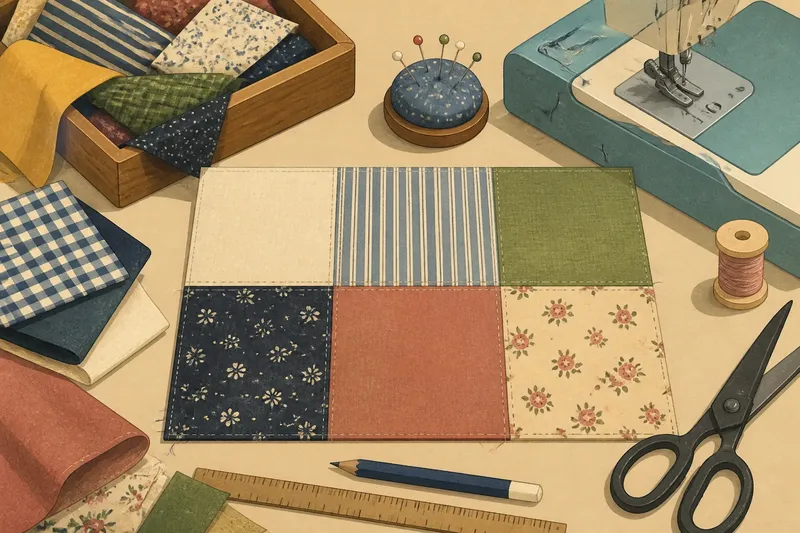
Lay out the fabric on a flat surface and group pieces by colour, pattern or texture. A subdued arrangement might place small prints beside plain cloth; a more lively one could alternate dark and light pieces. There is no requirement to make every section match. The useful question is whether the arrangement has a visual rhythm that you can live with.
Try a simple grid of squares or rectangles, which is easier to measure and sew than a collection of complex shapes. Put the pieces in order, then take a photograph or mark their positions on a quick sketch. This prevents an appealing arrangement from turning into a guessing game after the scraps have been stacked.
Say you have six usable pieces from a striped apron, a plain cotton pillowcase and a small printed remnant. You arrange them as alternating rectangles, with the apron cloth at the centre because it is the piece you most want to keep visible. The expected result is a modest panel in which the familiar stripe has a clear place without swallowing the other fabrics.
Cut pieces to a consistent size
Press the fabric if it is suitable for ironing, then trim away loose threads and uneven edges. Mark each shape with a ruler and washable pencil. Consistent pieces make seams easier to join and help the finished panel lie flat. A little extra fabric is needed at the edges of each piece for the seam allowance, so account for it when deciding the final dimensions.
Cut slowly and keep the fabric flat rather than pulling it towards the scissors. If a scrap is too small for the planned grid, set it aside for a later project instead of forcing it into a layout. A patchwork piece is not improved by making every available fragment earn its keep. Fabric, unlike a reluctant house guest, need not be included just because it is present.
Sew the layout into a stable panel
Place adjacent pieces right sides together and sew along the marked seam line, keeping the seam allowance consistent. Join small sections first, then sew those sections together in the order shown on the layout. Press the seams as you go, either open or towards one side; choose one approach that suits the fabric and keeps the panel flat.
At each join, check that the edges meet and the cloth has not slipped. If a seam wanders, unpick that section and sew it again rather than stretching the fabric to disguise the mismatch. For hand sewing, use small, even stitches and secure the thread ends. The point is not to erase evidence of making, but to keep the joins sound.
Once the panel is assembled, lay it flat and check for puckers, weak seams and any sharp, exposed edges. Trim loose threads. If the panel is for a cushion, add backing fabric and finish it as a cover; for a mat or wall hanging, a backing can protect the seam allowances and give the piece a more finished reverse.
Decide what the finished textile should remember
A keepsake does not need a written account attached to it. The maker can record a few plain details on a separate note: what the fabric was, who chose the arrangement, or where the textile will be kept. This can help a future owner understand why a particular stripe or faded flower was retained. The note is useful, not compulsory; the cloth is allowed to speak quietly.
In a community setting, patchwork can bring together scraps associated with a shared place, such as fabric from a club banner or a local sewing group’s projects. If several people contribute, agree on who will keep the finished piece and whether contributors want their names recorded. Asking first is kinder than treating every donated scrap as a public statement.
Patchwork also makes a distinction between preserving every object and preserving a connection. A textile can keep the colour, texture or pattern of a familiar item without pretending that the original garment remains intact. Like a well-used notebook, it carries signs of use rather than presenting itself as untouched.
How should you care for a patchwork keepsake?
Can different fabrics go into one patchwork piece?
They can, but fabrics with very different stretch, thickness or care needs may pull against one another. For an uncomplicated project, choose scraps with similar handling qualities and reserve delicate or stretchy pieces for a design made around them.
Should old clothing be washed before sewing?
Clean clothing first if it can be washed safely, then let it dry fully before cutting. This removes ordinary dirt and helps avoid surprises from fabric that changes after it is sewn; delicate garments may need a gentler approach.
How do you keep a patchwork panel from puckering?
Cut accurate shapes, avoid stretching the cloth as you sew and press each joined section flat. If the material shifts easily, clips can be more comfortable than pins, particularly near thick seams.
Can a small patchwork project be sewn by hand?
Yes. Hand sewing suits a small panel when the stitches are even and the thread ends are secured. It takes longer than machine sewing, but it also makes the work easy to carry between rooms or share around a table.
Let the cloth keep its ordinary character
When the piece is finished, choose care that suits its fabrics and construction. A small textile may be suitable for gentle washing, while an older or delicate piece may be better aired and spot-cleaned. Avoid storing it damp or pressed against rough objects that can snag the surface. If its component fabrics need incompatible care, gentler handling is the sensible choice.
The lasting appeal of patchwork is not that it turns scraps into something grand. It gives material another use and lets a familiar piece remain present in a new form. Start with cloth worth keeping, make joins that can bear use, and leave room for the arrangement to be simple. That is often enough for patchwork to become a keepsake without losing its useful origins.