A Family Recipe Card, Kept Without Turning It into a Display
Preserve a family recipe card with ordinary household materials while keeping its known context, useful details and private, handled character intact.
Which recipe card is worth keeping, and how can you keep it without making it an exhibit? For a family recipe card, the useful answer is to choose one for a reason, record what is actually known about it, and store it so it can remain part of household life without being handled carelessly.
A card need not be old, beautiful or written by a famous relative to matter. It may be the one used for a particular Sunday lunch, the recipe a neighbour gave your grandmother, or the card whose corrections explain why your family’s version tastes the way it does. Preservation starts by noticing that specific connection, not by making the paper look more impressive.
Choose a card with a clear place in family life
If a drawer contains several recipes, begin with the occasion or relationship that makes one card distinctive. Perhaps it belongs to a dish served at a regular family meal, a celebration that still brings people together, or a recipe associated with someone whose cooking is remembered. A useful choice has a reason that can be said plainly.
That reason does not have to be grand. “This is the card used whenever the cousins visited” is enough. The point is to keep a particular trace of how people cooked and gathered, rather than selecting the card that looks most presentable. A smudged instruction or a note in the margin may carry more of that history than neat handwriting.
Consider whether another copy already exists, but do not treat duplication as a reason to discard the original. A typed version may be easier to cook from, while the handwritten card retains a different kind of information: who altered the quantities, which ingredient was crossed out, or where a stain repeatedly landed. The copy serves the kitchen; the original preserves those marks.
Choose one card for this occasion rather than trying to settle the fate of every recipe in the house. A modest decision is easier to make carefully. It also avoids turning a small act of remembrance into a sorting project that requires its own cupboard and a stern expression.
Record what is known, and leave the gaps alone
Context is most useful when it distinguishes knowledge from family lore. Write down the recipe’s name, the person associated with it if known, and the occasions when it was used. If someone remembers making it for a particular gathering, record that as their recollection rather than presenting it as a settled fact.
Keep the note separate from the original card. A small sheet of plain paper can hold the context without adding new ink, pressure or adhesive to the recipe. Include the date you made the note if it helps a later reader understand when the account was recorded. A date is useful here as a record of the note, not as a claim about when the card was written.
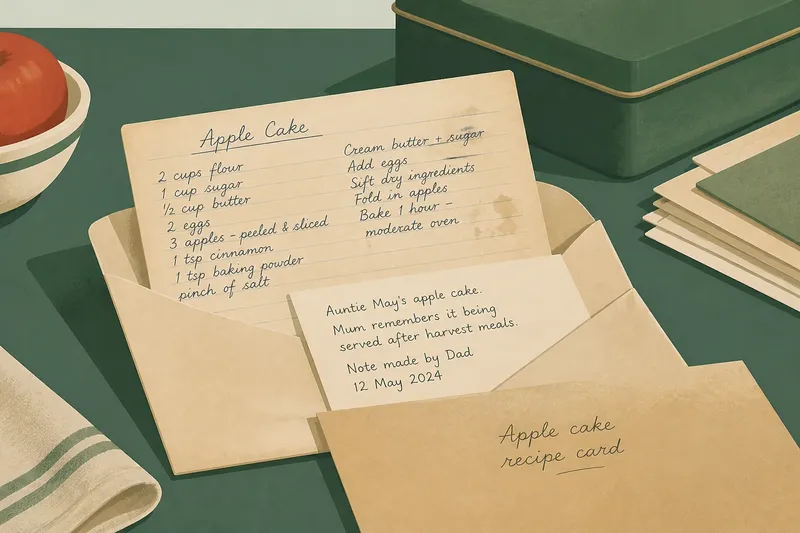
Use direct wording. “Auntie May’s apple cake; Mum remembers it being served after harvest meals” tells a reader who is speaking and what they recall. “The traditional family cake” sounds tidy, but leaves the reader unable to tell whose tradition or which branch of the family it belongs to.
It is equally useful to say what is not known. The card may have no name, and nobody may remember who first wrote it. Record that plainly. An unknown author is not a problem to solve by guessing; it is part of the card’s present context. Avoid adding a family story merely because the paper looks old enough to invite one.
Keep the original separate from kitchen use
A recipe card is a working object. Flour, oil, steam and repeated folding are ordinary companions in a kitchen, but they do not help paper last. If the card is still used, make a copy for cooking and put the original somewhere dry and out of the splash zone. A photocopy or careful transcription can preserve the recipe’s practical use while letting the original rest.
For storage, use materials already at hand: a clean, dry paper envelope, an uncoated folder, or a plain cardboard box. Choose something that keeps the card flat and protected from dust without squeezing it. If you use an envelope, write a brief description on it rather than on the card, and make sure the card can slide out without catching on a torn edge.
A small sheet of clean paper can separate the original from a loose note or a second card. Avoid wrapping it in cling film, laminating it, or sticking it to a scrapbook page. These treatments can trap moisture, add pressure or make later handling harder. The ordinary envelope is less dramatic, which is one of its better qualities.
Keep the card in a cupboard or drawer away from a cooker, sink, radiator and direct sunlight. A stable, dry place is preferable to a spot chosen for visibility. There is no need to build a display around it. A recipe card can remain part of family memory while being kept out of view, much like a spare key kept in a labelled drawer rather than mounted on the wall.
Make the storage useful to someone else
Preservation includes being able to find the card again. Put the envelope or folder with papers that are already kept in a dry household space, and add a simple label such as “apple cake recipe card”. If the context note is stored separately, indicate where it is. A future relative should not have to identify the card by opening every box in the house.
Keep the note brief enough to read at a glance. A few sentences can name the recipe, explain its known connection and identify who supplied the recollection. Long accounts tend to collect uncertain details and can obscure the simple point of the card. If more than one relative remembers the recipe differently, record the difference rather than editing their accounts into a single version.
Imagine you have found a handwritten biscuit recipe in a tin and your father recalls that his aunt made it for visits from the coast. You could copy that recollection onto a separate slip, noting that it is his memory, then place the card and slip in a clean envelope in a dry desk drawer. The expected result is modest: the original stays protected, the recipe remains identifiable, and a later reader can distinguish the card from the family account about it.
When the card is taken out, use clean, dry hands and support it on a flat surface. Handle it by the edges rather than rubbing a faded line or pressing down a curled corner. If it is brittle, stuck to another paper or shedding flakes, do not force it open; a conservator can advise on fragile material. For an ordinary card in sound condition, careful handling is usually enough.
What should you do with stains and faded writing?
Should you clean a stained recipe card?
Usually, leave a stain alone. Rubbing or dampening the paper can spread it, disturb handwriting or weaken the card, and a cooking mark may be part of its use. Keep the card dry and make a separate copy if the stain makes an instruction difficult to read.
Can you write on the back to add its story?
Use a separate note instead. New writing can obscure faint marks or make the card harder to handle, while a loose slip can be removed or updated without changing the original. Put the card’s description on its envelope or folder.
What if no one knows who wrote the recipe?
Record that the author is unknown and include only details someone can support, such as where the card was found or which relative kept it. You do not need to supply a name to make the card worth keeping. Honest uncertainty is more useful than a confident guess.
Should the original be used for cooking?
Make a kitchen copy and keep the original in dry storage if repeated use would expose it to spills, heat or handling. A typed transcription can also preserve corrections and unusual wording if you copy those details faithfully. Check the original before relying on a transcription, especially where an ingredient or instruction is unclear.
Let the card stay an ordinary family object
There is a difference between caring for a recipe card and presenting it. A frame, a specially staged shelf or a polished label may suit some households, but none is required to make the card meaningful. If the family wants to display it, that can be a separate decision; the card’s value does not depend on being seen.
For a family recipe card, the practical aim is a clear choice, a truthful account and storage that suits the paper. The context can grow if someone later remembers more, while the original remains untouched by each new recollection. Kept in an envelope with a short note, the card stays available to the household without being asked to perform as decoration.
When you next come across a recipe card, ask what specific occasion or relationship it carries, then write down only what you know. That small pause can preserve more than a recipe: it keeps the boundary between the paper itself and the family memories gathered around it.